
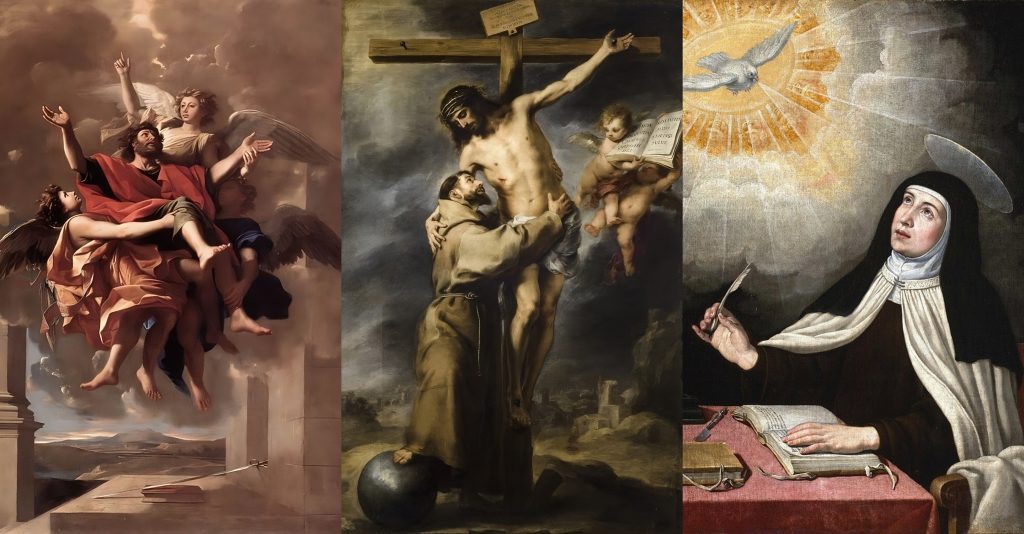
What is prayer?
Prayer is the elevation of the interior life.
The interior life is the intimate conversation which everyone has with himself as soon as he is alone, even in the tumult of a great city. From the moment he ceases to converse with his fellow men, man converses interiorly with himself about what preoccupies him most. This conversation varies greatly according to the different ages of life; that of an old man is not that of a youth. It also varies greatly according as a man is good or bad.
As soon as a man seriously seeks truth and goodness, this intimate conversation with himself tends to become conversation with God. Little by little, instead of seeking himself in everything, instead of tending more or less consciously to make himself a center, man tends to seek God in everything, and to substitute for egoism love of God and of souls in Him. He begins to truly love himself – not in an egotistical fashion, but because He recognizes that God loves him. And likewise, he loves all other men as himself for the same reason. He lives with a joy which does not waver in the face of passing circumstances.
Conversely, the interior life of the base man is something more animal than divine. He is more acquainted with the rush of pleasure than with the constancy of joy. He is more acquainted with the fear of capricious human consequences than with God’s eternal judgment. These passions please or hurt him as the weather is good or bad, or as he earns or loses money. His intimate conversation is always related to objects of cupidity or envy. He inevitably puts power, pleasure, honor, or wealth in the place of God. Never finding anything which fully satisfies him, he tries to flee from himself to forget the emptiness. He ends in hating life because he desired too greatly what was inferior in it.
Prayer is, again, reorienting the mind away from the world and toward eternity. The natural man prefers the mutable good of fancy clothes to the eternal good of humility. When that man dies, he will not take his clothes, but he will take his vanity. The miser will not take his money, but he will take his greed; the lothario will not take his sex, but he will take his unquenchable desire for it. The world, the flesh, and the devil are concerned with surrounding us with all kinds of mutable goods to dull our souls into unconsciousness; God is concerned with lifting us above these things, making our souls sensitive and super-conscious. Once again – the means of achieving this is prayer.
Virtue
Many believe that some vague, minimal level of goodness is sufficient to reach Heaven, and that sainthood is going “above and beyond.” And indeed, no one needs to perform great miracles or be canonized by the Church to be saved. No one needs some high level of culture or intellect to be saved. But it is necessary to be a saint to be saved. Everyone in Heaven is a saint. If you are not a saint, you cannot be in Heaven.
Is this unfair? Asking too much? Certainly not: if sinners are willing to give up everything in the pursuit of their meaningless ends – power, pleasure, honor, wealth – how much more tenaciously should the saint pursue the good of his eternal soul? Ought not man to love his soul more than his body? “Or what exchange shall a man give for his soul?”
To save our soul, one thing alone is necessary: to hear the word of God and to live by it. Thus, virtues – good habits – are one major component of the prayerful life. Specifically, I speak of supernatural virtues, which are the sovereign gift of God, normally communicated through baptism. While a natural virtue is oriented toward an object, supernatural virtue is oriented toward God. For example, the man with natural virtue may demonstrate religiosity to be recognized in his community, but the man with supernatural virtue demonstrates religiosity purely because he loves God. Or, the natural man may diet to lose weight, while the supernatural man fasts as a penance. Or, the natural man may not marry to avoid financial difficulty, while the supernatural man might give up marriage to become a missionary.
Man’s major responsibility in this realm is the elimination of vice. As man eliminates vices through his action, God provides greater supernatural virtue through His action. Now vices are simply excesses or defects in one’s relationship to a virtue. For example, an excessive relationship with courage is stubbornness, while a defective relationship with courage is cowardice. I say the relationship can be wrong because one can never have an excess of the actual virtue. More virtue is always good. Vice is really a false relationship with some virtue.
I will describe the three theological virtues and the cardinal moral virtues and their related vices.
Theological Virtues
Charity, the love of God and love of neighbor for God’s sake, is the first and greatest virtue. As St. Paul says: “If I speak in the tongues of mortals and angels, but do not have charity, I am a noisy gong or a clanging cymbal. And if I prophesy, and understand all mysteries and knowledge, and if I have faith enough to move mountains, but do not have charity, I am nothing. If I give away all my possessions and hand over my body so that I may boast, but do not have charity, I gain nothing. Charity is patient; charity is kind; charity is not envious, boastful, arrogant or rude. It does not insist on its own way; it is not irritable or resentful; it does not rejoice in wrongdoing, but rejoices in the truth. It bears all things, believes all things, hopes all things, endures all things.”
There is technically no such thing as a true “excessive” form of charity, since it is impossible to love God too much, but to truly love Him even a little bit suffices to achieve Heaven. The term “excess” really means “complete counterfeit” in regard to these virtues. That said, the defective form of charity is hatred of God – spiritual sloth, indifference, or hostility.
Faith is an infallible, direct act of the mind which assents to revelation on the basis that God revealed it. In the natural order, this is comparable to metaphysical principles like cause-and-effect or the law of noncontradiction; these principles are impossible to demonstrate, they are simply known. They are “above” discursive reason. Though reason defends and nurtures faith, faith stands above reason and guides it. Consequently, faith can only enter the mind the same way the intuitive understanding of metaphysics can enter the mind: God Himself must infuse it there. Concretely, faith manifests in man assenting to the teachings of the Catholic Church instead of the whims of his own heart. The virtue of faith is, essentially, the sacrifice of the mind to God. The defective form of faith is to withhold from God by unbelief – apostasy, heresy, or otherwise.
Hope is the virtue by which one trusts God to help them attain salvation. If faith is trusting that seeds grow into trees, hope is going to the garden and watering them daily. Hope is expressed in a disciplined prayer life and frequent use of the sacraments. The defective form of hope is despair, which abandons the way to righteousness for fear of failure, as if God is not powerful enough to save whomever He wills.
Moral Virtues
Prudence is the highest moral virtue, which is simply judging well the means to attain salvation. Prudence consists of seeking out and taking good counsel with docility, measuring it against experience, and shrewdly applying it to the circumstances of one’s life. A prudent man may know, for example, that money never fully satisfies, and so takes a lower-paying job to spend more time in prayer. The “excess” of prudence is cunning, which is the effective use of reason to achieve evil ends. The defective form is thoughtlessness, which is a negligent disregard for the means of salvation.
Justice is rendering another his due, whether God, or one’s neighbor for the sake of God. Justice has many facets, but can generally be described as paying back what one owes, whether to another sovereign individual, or to the government, or to the poor, or to authorities. But justice does not only apply to sterile types of transactions. Justice is the root of gratefulness, honesty, and friendliness. The vicous excess of justice is to claim more than one is due, whereas the defect is to do less than one ought.
Fortitude is the willingness to engage in the arduous for the sake of God. The person with fortitude seeks excellence in all things, accepting that this almost always means difficulty. This might manifest in excellent use of resources, the patient bearing of evil or awaiting of goodness, perseverance, and love of suffering. The perfect example of fortitude is Christ bearing the cross. The excess of fortitude is rashness, which is a love of arduous things for the sake of arduousness. The stubborn man is often obsessed with his manliness and ability rather than simply achieving his duty. On the other hand, the coward shies away from difficulty purely because it is difficult. He often comes up with excuses, such as being too humble to seek excellence, when really he is just too afraid to try doing anything great.
Temperance is the ability to moderate the appetites for the sake of God. Temperance is most manifest in integrity – always seeking what is virtuous, as opposed to what feels good. The temperate man is sober, chaste, continent, modest, patient, and simple. Through prudence he recognizes his total dependence upon God, but through humility he lives it. He learns what he needs to learn and ignores distractions. He knows when it is time to rest and when it is time to work. The excess is intemperance, which is the unrestrained pursuit of pleasure. The defect is insensibility, which is an immoderate attachment to ascetisim, such as the father of a household trying to give up all his worldly goods.
Of course, beyond the virtues are the Gifts of the Holy Spirit, which you can read about at length here.
The Act of Prayer
St. Paul instructs Christians to “pray ceaselessly.” For one part, this refers to the commission of virtuous actions as described above, which are indeed prayer. But it primarily refers to cultivating a contemplative union with God, through which we, like Christ, may only move when the Father moves us; so that we may only judge with the wisdom of Christ; so that we may only speak when the Spirit of Truth speaks through us. All Christians are called to a profoundly deep, contemplative prayer life. This is, after all, what we should expect in Heaven.
There are two “basic “beginner” forms of prayer – vocal prayer, and meditation. Of the two, meditation is the higher, and should practically always accompany vocal prayer once one is past childhood. The ordinary way to practice meditation is by reflecting on a certain aspect of scripture. This has three parts. First, consideration. For example, one may read the parable of the rich man and Lazarus, pausing to think about the spiritual realities of the story. Second, application. That parable may lead one to meditate on their own relationship to material possessions, or their mindfulness of the poor. Finally, resolution. Good discursive meditation ends with the firm will to act – in this case, perhaps by dedicating extra money to charity.
The Rosary is one of the most popular forms of meditation. My synopsis of the Gospel follows the mysteries of the Rosary. It is a good resource for guided meditation.
There are a few critical concepts to always bear in mind. First, the importance of general preparation by rule of life. A man cannot pray tranquilly when he is overcome by many trifles, much less when he is battling sins of the flesh. This is why growth in virtue and progress up the mount of contemplation go hand-in-hand. Second, particular preparations; even with the general issues overcome, it is difficult to pray well without particular preparations, such as bearing the future topic of meditation in mind from the time of waking to the time of prayer. Third, to always use imagination as a springboard, but never as an end, knowing the end of prayer is to transcend phantasms. Finally, focusing on specific meditations related to personal duties and plans of action. How do I feel when honored? Elated? That’s pride. I will start saying a litany of humility daily.
And what is the ultimate goal of prayer? To transcend mere concepts and approach the invisible, ineffable Creator by purity of heart and mind. Becoming God by intimate participation, not speculation; becoming God as a husband and wife become one, not as one learns a skill by reading a textbook. Over time, prayer should make us such that we are only distinct from God as a window is distinct from the light shining through it. The following section describes this process, following Garrigou-Lagrange’s masterwork on the subject:
Three Ages
The spiritual life is a progression of “three ages” – the purgative, the illuminative, and the unitive. One ascends through these levels through a combination of destroying vice and meriting an increase in supernatural virtue through prayer. Virtue and prayer grow together as the fingers on the hand.
Purgative
The first age is that of the beginner. The beginner may be a new convert to Catholicism, a child, or someone who returns to the Church after many years away. The beginner does not know God very well. Attachments taint their mind, and their ways are natural. They have an initial knowledge of themselves, and little by little they discern their defects. If they are generous, they seek to correct themselves without exception. Their self-reflection must be constant in order to overcome their deeply ingrained vices. However, this self-knowledge remains superficial for a long time. Often, they begin to recognize the egoism of others before their own, liking to think themselves holier than they are. Their knowledge of God is largely factual or emotional, not experiential.
Many beginners neglect the mortification necessary for their growth. They resemble a man who would like to begin climbing a mountain, not from the base, but from halfway up the side. The fire within them is merely a spark of self-interested enthusiasm, and it dies quickly. With only bare, superficial knowledge and experience of the divine, they abandon spirituality, thinking they had reached the heights and found nothing. Some beginners take an unusual level of delight and comfort in spirituality, which is not a bad thing in itself, but it can become a crutch. Come discomfort and they will try to repeat the things which make them feel good instead of striving for greater holiness. Another pitfall for beginners is religious egoism, like that of the pharisees. They practice religion to feel good about themselves, not to render justice to God.
Generous beginners progress by way of the sacraments and mortification. Inevitably, all beginners reach a choice: to be well, or to be a saint. The generous souls are unlike the rich young man who shied away when told to sell all that he owns. They understand the supreme value of union with God and press onward, rejecting all temptations of the world. God condescends to the beginner, building a foundation of discursive knowledge with them to prepare for greater union to come. This includes natural and even base consolations. The beginner relies very much upon positive emotions, images, and examples, the sensorial experience and novelty of Mass, prayer, and spiritual reading, and so forth.
The Dark Night of the Senses
The beginner who presses onward generously and patiently will eventually reach the first trial: the “dark night of the senses.” The beginner, for all their effort, cannot fix their own self-reliance, self-interest, and dependence on low things. God remedies this by taking away sensible, base comforts. This does not only include physical delights, but interior attachments like reliance on memory, forms, and images. It is only by this forfeiting of natural judgments and methods that the soul “makes room” for more contemplation (more on that in the next section). St. John of the Cross notes that, far from reducing man to a beast, forfeiting these natural methods lifts him above the carnal reliance to reliance upon God. The Spirit is a much better guide than our sensible faculties, as He cannot be tempted by the world, bargained with by the senses, or tricked by the devil.
The beginner attains a deep, penetrating, uncomfortable understanding of the meaninglessness of created things, even including the good emotions that come with spirituality. The beginner may become confused and believe they are backsliding or becoming depressed, as it feels the world is being torn away from them. But if they press onward in a spirit of faith, they will find that the material world is not being taken away; rather, the spiritual world is being given. Through this weaning, they come to realize that holiness does not consist in “feeling” God’s presence, but in doing God’s will.
Illuminative
Virtue rules the soul in the illuminative way, as opposed to sensible considerations. However, the illuminative soul is not dominated by virtue; good behavior still takes significant effort. The soul in this state has a keen and constant awareness of the emptiness of material things. Their fear of the Lord and piety drive them toward good penances and a strong prayer life. They are aware of their helplessness from the experience of the night of the senses, and through this awareness the soul in the illuminative way is docile to the inspirations of God. They begin to understand God’s will, both through the gift of prudence and the beginnings of infused contemplation.
Contemplation is a higher form of meditation, infused by God to draw one into a more supernatural union. Contemplation is mysterious and often evades understanding. In some cases – as have been noted by several saints – God may infuse in one a deep understanding of the Trinity – yet upon trying to explain what they saw, they find themselves as one trying to describe color to the blind. In many cases, deep and fruitful contemplation can feel like nothing at all. St. John of the Cross compares contemplation to being in a room with one pure particle of light. On account of its total purity, it would illuminate nothing; likewise, God’s purest presence is often experienced – in this life – as darkness.
St. John offers a few words on how to know one is ready for this contemplation. First, they ought to have a strong foundation in discursive Catholic understanding. Second, they ought to have a strong prayer life built on active, discursive meditation on the divine mysteries. These accomplished, the soul must await the Master’s call, which manifests as a weariness with the fruits of discursive meditation. At that point, the soul must simply avoid resisting the movement from active reasoning to passive intimacy. This may be something as simple as sitting before the Blessed Sacrament in adoration, and, upon interior prompting, putting down one’s book and staring at Him, devoid of thought. St. John says that the untrained often see this as backsliding, thinking reading their book is more productive. But it is, of course, quite the opposite. Moments in simple, pure, adoration are the most profound preparations for Heaven.
St. John of the Cross writes that those who persevere in prayer will become proficients. However, not all among the proficient attain continual contemplation. Many remain in the illuminative way, contemplating in fits and starts and fighting their imperfections with constant effort their entire lives. Those who do attain a high degree of spiritual perfection in the illuminative way only do so by constant trial. It is from this stock that a few – very few – are chosen to undergo the next spiritual metamorphosis.
The Dark Night of the Soul
The night of the soul is the most exacting spiritual trial. At the heights of the illuminative way, the soul begins to properly understand the grandeur of God, but also understand all the hidden defects of their own soul. The contrast is overpowering, like the brilliant light of the sun shone in the eyes of a night-owl. The temptations of this trial are not against the moral virtues, as in the night of the senses, but the theological virtues. Faith, hope, and charity are tested by temptations of doubt, despair, and self-hatred. This divine clarity causes – and I cannot emphasize this enough – extreme suffering. Suffering for Christ is a relief compared to this suffering – this is why the saints rejoice in their persecutions! This is why St. Andrew, upon seeing his cross, wept like a man seeing his bride on their wedding day.
The soul here is in a state of impassivity. It does not recognize new faults within itself, but feels a deep separation from God. But in spite of this aridity, the generous soul perseveres in habitual avoidance of sin and good works.
Unitive
The unitive soul approaches spiritual perfection. Their state is marked by a profound detachment from the world and abandonment to God’s will. Note the phrase “abandonment to God’s will.” Some confuse the description above of the beginnings of the unceasing prayer of the saints to be reminiscent of Buddhist or stoic meditation. This is not at all so; Buddhists and stoics meditate to reject and escape externalities. The saints, like Christ, meditate with God to achieve union with Him amidst externalities. The saints accept suffering just as readily as pleasure – each with total detachment, each for pure love of God. Like a child leaping into his father’s arms without any doubt that he will catch him, the saint habitually dwells in the “darkness” of faith with ease and sweetness.
Their virtues are outright heroic, particularly charity, faith, and humility; their patience almost unalterable. For a unitive soul, all suffering is external. That is, all suffering comes from without; there is no interior contradiction like anxiety or lust or vainglory which causes them suffering.
Briefly: the unitive soul is a paragon of virtue and a walking image of Christ. In some sense, they serve as a living conscience for others, as their holy presence often causes others to behave better. Contrary to being extraordinary, everyone should reach the unitive way, as it is the essence of saintliness. Of course, those within the unitive way may have varying degrees of perfection, as Jesus is more perfect than Mary, though both were spotless.
How to Achieve Union
If this sounds a bit abstract, allow me to interpose some concrete steps toward preparing oneself for contemplation. First, the prayer life. In strongest terms, I would recommend recitation of the Divine Office – at least Lauds – daily. The Church entrusts the souls of men with Holy Orders to the recitation of the Divine Office; surely, it will keep you safe. I use the iBreviary app (guide). Second, a daily Rosary – only one Apostle did not flee when Christ was being crucified: the one who stayed close to Mary. All the saints encourage us to entrust ourselves to her. Third, meditate using the “Jesus prayer”: gaze at an icon, inhale, say “Lord Jesus Christ, Son of the Living God,” exhale and say “have mercy on me, a sinner,” and repeat.
Next, works. Most importantly, attend Mass as frequently as possible, preferably daily, and try to gain plenary indulgences for the souls in Purgatory as you do. If every time one went to Mass they received $50,000, morning Mass would be packed every day. And yet, what is there? The body of Christ, given to us specifically as the easiest, simplest, most effective route to Heaven. $50,000 is a pittance in comparison. Further, freeing souls from Purgatory ensures a host of saints in Heaven praying for you and with you. Second, work on eliminating all pleasures in your life which are not related to carrying out your duties. Third, fast on Wednesday and Friday. These practices develop interior detachment to all created things – a virtue which, I remind you, is necessary for contemplation.
Finally, resources for discursive understanding. Remember, one must walk before they can run; one must reason before they can transcend reason. The best place to start reasoning are books! Picking books to read is far more subjective than the above recommendations, which are ancient Church traditions, but these are ones I find particularly helpful: The Bible, the Summa, Three Ages of the Interior Life, Ascent of Mt. Carmel, Introduction to the Devout Life, and anything by St. Augustine.
I will also mention, I’ve found it incredibly edifying to learn basic Latin, particularly for recitation of the Office. Pope Paul VI called Latin the “richest treasure of piety,” and many other Popes have encouraged its use among laypeople. It is the sacred, chosen liturgical language of the Latin Church, as Hebrew was for our forebears. It is not that hard to grasp the basics. Here’s a good article on the topic. A good book to start with is LLPSI: Familia Romana.
Let me reiterate: it’s not as if this is a list of my subjective ideas. I didn’t make these up. Everything noted above is either a centuries-old Church tradition, scripture, or a writing from a Church Doctor. Are all these practices absolutely necessary for achieving contemplation? No. Am I a spiritual master, a monk or a Bishop? Again, no. But I fail to see how anyone who practices the above with discipline and fervor, taking care to avoid the spirit of pride, could fail to achieve an extraordinary spiritual height.